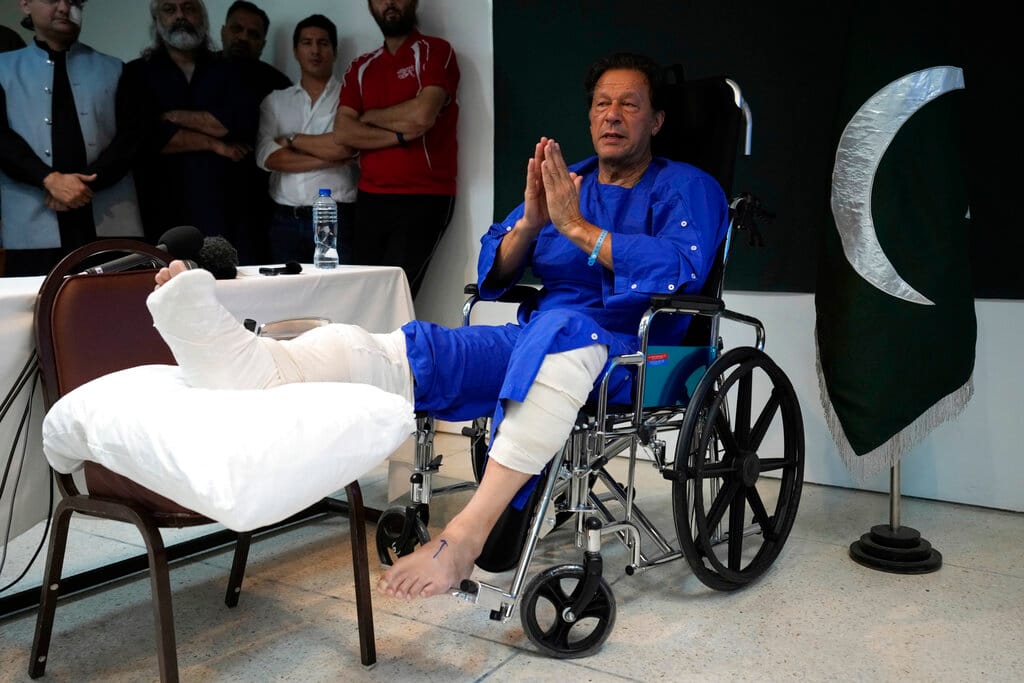
On Sunday, Khan announced that the “long march” would restart from Wazirabad, about 190km southeast of the capital. The demonstration was halted last Thursday after Khan’s convoy was hit with gunfire. Khan was shot in the leg in what his party, Pakistan Tehreek-e-Insaf (PTI), termed an assassination attempt.
Analysts say the shooting has sparked widespread public sympathy for Khan, who has been at loggerheads with the government since he was removed from office in a no-confidence vote in April. Khan wants snap elections, while Prime Minister Shehbaz Sharif’s administration has insisted they will be held later next year as scheduled.
Due to his injuries, Khan will address the march virtually from his home in Lahore for now, having been discharged from the hospital. He said that he intends to physically rejoin when the procession enters Rawalpindi, the twin city located adjacent to Islamabad. Khan said on Sunday that he expects the march, which started on Oct 28, to reach the capital sometime between Nov 18 and 22.
Sabookh Syed, a political analyst based in Islamabad, suggested that the shooting has created a tailwind of goodwill for Khan. The attack “has put the government in a defensive position and further strengthened the movement of Khan”, he told Nikkei Asia.
After the shooting, Khan’s party quickly accused Prime Minister Sharif, interior minister Rana Sanaullah and a top official of Pakistan’s leading intelligence agency of being behind it, without offering any evidence. A First Information Report – the initial police report – has yet to be filed.
Tahir Naeem Malik, a professor of International Relations at NUML Islamabad, said that Khan’s party and the ruling alliance are stuck in a political deadlock. “Due to the political polarisation in the country, no undisputed institution is left which can mediate between government and opposition,” he said.
Malik explained that in the past, Pakistan’s military establishment had played an arbitrator role. But given Khan’s accusations against “certain army officers and the general hostility showed by the PTI toward the military establishment, now this does not seem a feasible option for mediation”, he said.
While the government and its allies are criticising Khan at every possible forum, experts believe the star cricketer turned populist politician is winning the battle of narratives.
“A perception has spontaneously emerged that all state institutions and political parties are against Khan and he alone is battling with them,” said Syed, adding that Khan has played his cards well.
Nevertheless, most experts believe Khan is unlikely to get his wish for early elections – partly for practical reasons, as the country continues to reel from devastating floods coupled with an economic crisis.
“Given the damages caused by floods, and the time required by the election commission in completing the constituency delimitations, early elections are practically not possible irrespective of the magnitude of pressure put by Khan,” Malik said.
He believes that, at best, Khan’s movement might accelerate the vote by two or three months ahead of the scheduled timing of October 2023.
Meanwhile, Islamabad is bracing for further unrest.
After Khan was shot and his march was suspended, the Islamabad capital administration removed barriers that had been set up to prevent PTI marchers from entering. The capital police also sent back contingents of officers that had been called in from Sindh and the Frontier Constabulary.
On Sunday, however, the capital police announced that they were calling the reinforcements back in. They also apologised to the public for the inconvenience that will be caused in the next two weeks by barriers placed to maintain public order.