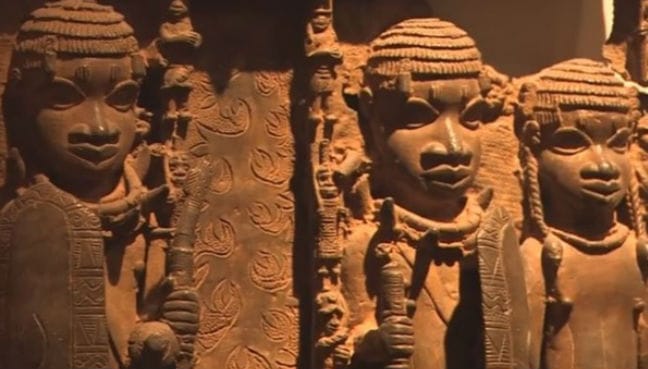
British soldiers seized thousands of metal castings from the then-separate Kingdom of Benin in 1897, one of a series of acts of plunder that have long tainted relations between London and the territories where its agents held sway in the 19th century.
London has resisted campaigns for the full return of Nigeria’s bronzes, Ethiopia’s Magdala treasures, Greece’s “Elgin Marbles”, and other relics, often citing legislation that bans its museums from permanently disposing of their collections.
But Godwin Obaseki, governor of the southern Nigerian state of Edo where Benin City is located,said he had been talking to European museum officials who have floated the idea of returning the objects on loan.
“Whatever terms we can agree to have them back so that we can relate to our experience, relate to these works that are at the essence of who we are, we would be open to such conversations,” Obaseki said.
The Benin haul, which included thousands of metal plaques showing intricately-cast scenes from court life as well as ivory and wooden carvings, all recognised treasures of African art, was split across museums in the UK, mainland Europe, and New Zealand.
Obaseki said he was discussing the loan idea with the country’s National Commission for Museums and Monuments (NCMM) and local authorities had already earmarked a site for a new museum to take the returns.
“In some cases it could be a permanent loan, and in some cases it (could) just be for temporary display. In other cases it could be a return of works,” he said, speaking at his residence in a bustling inner district of Benin City.
The NCMM said senior officials had held talks with representatives of European museums to discuss a loan. “Nigeria is not adverse to loan of artefacts,” said a NCMM spokesman.
Obaseki said he had been in touch with a group of representatives from European museums called the Benin Dialogue Group who, according to media reports, had suggested moving towards a permanent, but rotating, exhibition of loaned objects in Nigeria. Up to now, it was unclear how Nigeria would respond to the idea.
Other governments, including Ethiopia and Greece, have rejected the idea of loans and demanded full returns, saying they should not have to borrow their own stolen property.
The British Museum, which lent one of the “Elgin Marbles” in its collection to Saint Petersburg’s State Hermitage Museum in 2014, said it had not received a formal request for any loans from Nigeria’s government.
“But we are open to consider any specific proposals when they are made and we remain in dialogue with NCMM,” its added in a statement.
The museum has regularly argued that it preserves the objects in its care and exposes them to a global audience. “There continues to be a public benefit in people being able to come and experience these objects in this world collection,” said Hannah Boulton, a British Museum spokeswoman.
The art of crafting works from metal has persisted in Benin, more than a century after the British ransacked the palace.
Eric Ogbemudia, 62, who is the latest in a long line of sculptors in his family, said the bronzes should be returned.
“We will be happy if those stolen artifacts are brought back to Benin. But they stole them. Those items are the works of our forefathers and they are very unique to us,” he said.