The expansion of an accord dating to 2000 comes as Mexico fights hard to preserve a three-way free trade agreement with the US and Canada, which is crucial to all three economies.
The EU is Mexico’s third-largest trading partner, lagging far behind the US and China.
Mexican President Claudia Sheinbaum has stressed the importance of “opening other horizons” at a time when both Mexico and the EU are grappling with US President Donald Trump’s tariff offensive.
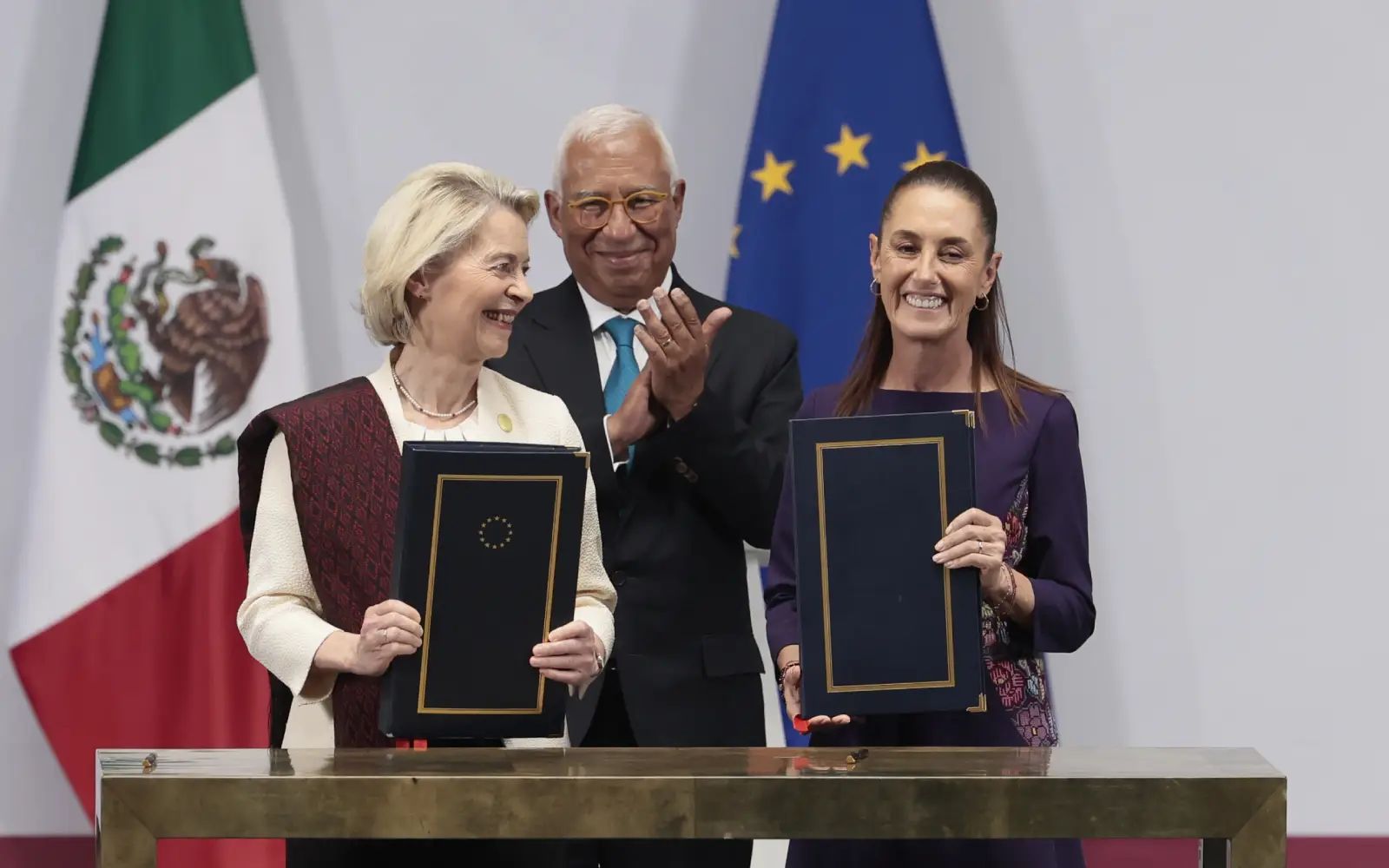
The updated agreement, signed by Sheinbaum and European Commission President Ursula von der Leyen during the eighth EU-Mexico Summit, removes most remaining barriers to trade and investment.
“At a time marked by increasing turbulence and profound transformations, we have chosen to expand, deepen and update the bonds of our Strategic Partnership,” a joint statement read.
‘The same objectives’
The updated accord facilitates trade in auto parts, a sector particularly affected by Trump’s tariffs.
Mexico also agreed to recognize hundreds of food and drink products from specific EU regions, such as Parma ham and Roquefort cheese.
The agreement will lower tariffs on more products, and give duty-free access to pasta, chocolate, potatoes, canned peaches, eggs and certain poultry products.
“Mexico wants to reduce its dependence on its northern neighbor, but also on Asian, or rather, Chinese, supply chains, and in Europe we are pursuing the same objectives,” an EU official told AFP on condition of anonymity.
On a visit Thursday to Mexico City, the EU’s foreign policy chief Kaja Kallas said the deal would create new opportunities for “both economies to compete globally” and build on the momentum of the past decade, which has seen a 75% leap in EU-Mexican trade.
Earlier this week, the EU moved to end a trade standoff with Trump by agreeing to implement a deal signed last year with the US, which sets tariffs on most European goods at 15%.
Average US tariffs on Mexican goods are a quarter of that — with many avoiding levies altogether under the United States-Mexico-Canada Agreement (USMCA).
Sheinbaum said Mexico’s respective trade agreements with the EU and the US were “not contradictory”.
“On the contrary, they strengthen Mexico, strengthen Europe and strengthen the United States,” she told a press conference.
Brussels has said the update to the pact would make it easier for “like-minded partners” to export and invest in each other’s markets.
The lower tariffs enjoyed by Mexico will benefit the EU, according to Sergio Contreras, president of the Mexican Business Council for Foreign Trade.
Mexico will be “the point of convergence, the platform for the European Union and North America to come together,” he said.