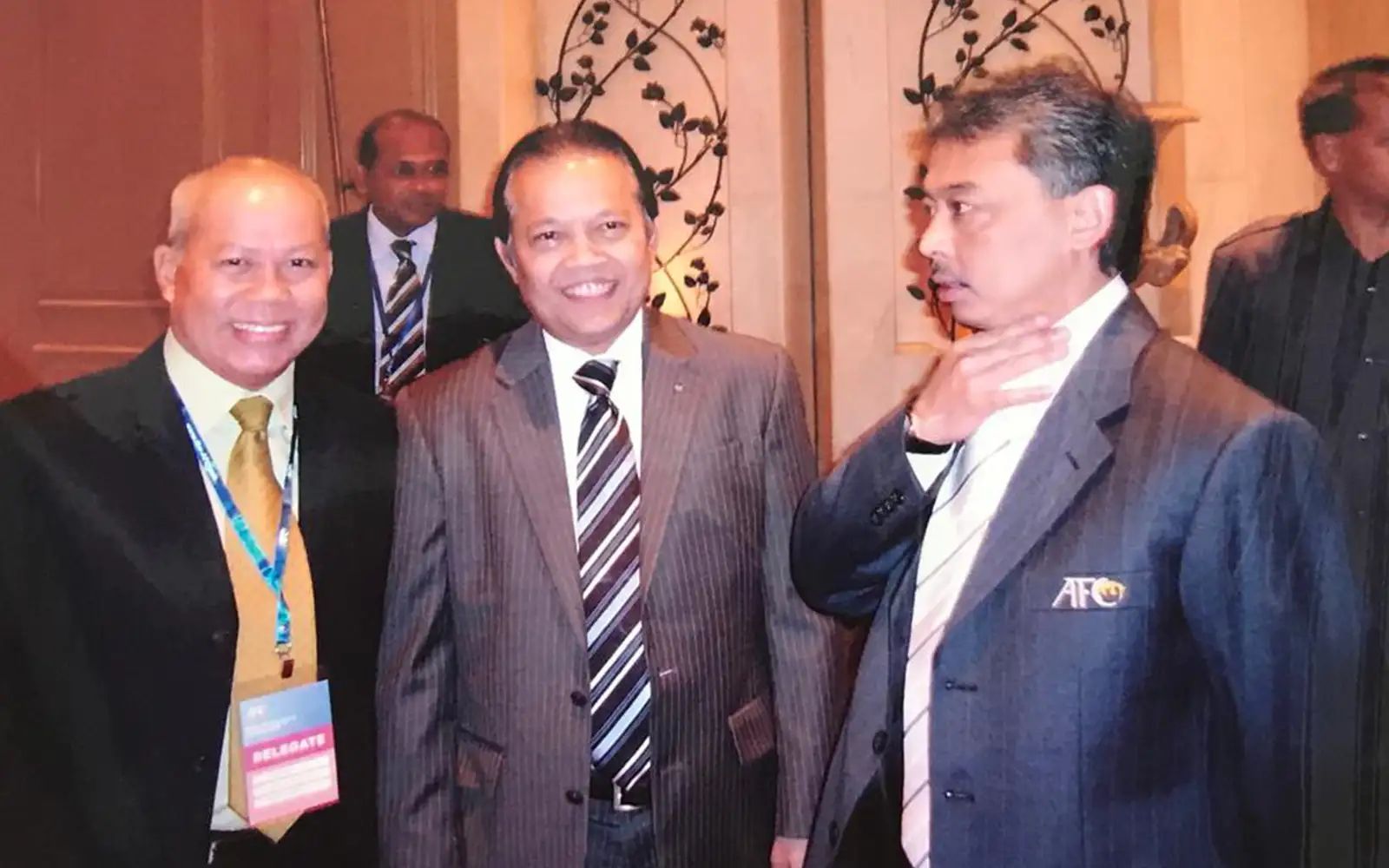
Thai football stalwart Worawi Makudi has publicly urged Al-Sultan Abdullah Sultan Ahmad Shah to consider assuming the presidency of the Football Association of Malaysia (FAM).
He becomes the first senior football figure from outside Malaysia to do so.
The former Fifa and Asian Football Confederation (AFC) executive committee member’s intervention matters because of who he is, and when he has chosen to speak.
From 1997 to 2015, he sat at the heart of Asian and global football governance, serving on both the powerful committees during a period when the region was tightening governance standards, expanding commercial frameworks and deepening cross-border cooperation.
During that same era, he worked closely with Al-Sultan Abdullah, then an influential figure within Asian football administration.
“Our working relationship was phenomenal,” Worawi said. “We were aligned on how football in this part of the world needed to be run — professionally, transparently and with respect for the game.”
He was unequivocal in his assessment of the Sultan’s suitability.
“Al-Sultan Abdullah is a man of vision,” Worawi said. “His heart is still with football. He understands not only how the game is played, but how it must be governed.
“If Malaysian football needs someone to steady the ship and rebuild properly, he is a natural choice.”
The significance of Worawi’s support lies not in nostalgia, but in institutional memory.
He represents a generation of administrators who viewed football governance as stewardship rather than entitlement, an approach many in the region believe has been eroded.
During his tenure as president of the Football Association of Thailand, Worawi recalled close working ties with Malaysia’s football leadership, shaped by mutual respect and shared objectives.
“When I headed the FA of Thailand, our relationship with FAM was top-notch,” he said. “The late Sultan Ahmad Shah and Al-Sultan Abdullah — we worked like family. There was trust. There was purpose.”
That memory has sharpened his concern over recent events in Malaysian football.
FAM is currently facing intense scrutiny following the naturalisation scandal involving seven players, where falsified documents led to FIFA sanctions, fines and overturned results.
The fallout triggered the resignation of FAM’s executive committee and prompted an AFC review of the association’s governance.
A full hearing at the Court of Arbitration for Sport (CAS) is scheduled for Feb 26, a date that could shape FAM’s legal standing and international credibility in the months ahead.
Oversight and leadership culture
For Worawi, the crisis exposes deeper issues.
“This is not about one mistake,” he said. “It is about systems, oversight and leadership culture. When governance weakens, problems multiply. That is why leadership at the top matters so much.”
He believes Al-Sultan Abdullah’s value lies in his ability to reconnect Malaysian football with regional and global confidence.
“He understands how decisions in Kuala Lumpur are viewed in Zurich and Kuala Lumpur alike,” Worawi said. “That perspective is critical now. Football does not exist in isolation anymore.”
He said the Sultan’s past contributions remain widely recognised across Asia: introducing professional football structures in Malaysia, playing a role in the early growth of the Asean Football Federation, and contributing to Fifa initiatives such as school-based football programmes.
Yet Worawi stressed that this is not a call to return to the past.
“This is about moving forward with the right foundation,” he said. “You need leadership that people trust instinctively at home and abroad.”
Worawi’s voice has shifted the tone of the conversation.
What was once framed as a domestic plea has now become a matter of regional interest.
As Malaysian football approaches a critical junction, the message from across the border is measured but clear: credibility is built slowly, lost quickly, and recovered only through principled governance.