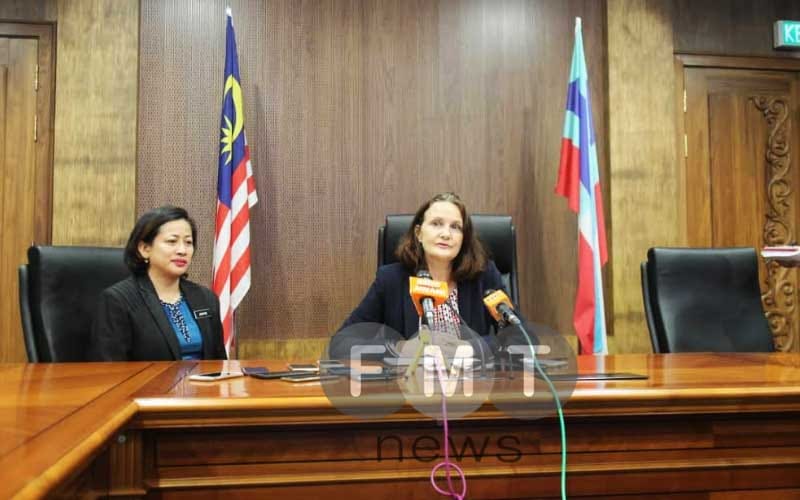
Unicef representative to Malaysia Marianne Clark Hattingh says efforts to help them were made difficult in the past because undocumented children were considered a security issue.
“We are encouraged with the chief minister’s (Shafie Apdal) willingness to address this issue, to see it as a human rights and development issue — not just a security issue,” she said after a courtesy call on Shafie here today.
She said with the government appearing to be more receptive now, there was an opportunity to make a difference and give the children opportunities to develop to their full potential.
Hattingh pointed out that allowing the issue to worsen will continue the vicious and tragic cycle of stateless children ending up in poverty.
“These children don’t have access to education or health care, and you perpetuate a cycle of poverty. So I think it was a missed opportunity in that regard.”
She said the United Nations Country Team is conducting a study, together with Universiti Malaysia Sabah (UMS) and state think tank Sabah Institute of Development Studies, on stateless children.
“We are also doing another study on poverty, looking at Kota Kinabalu and Sandakan, and doing a deep dive on this. This will mirror the study we did in KL on child poverty.
“This will complement the findings of the other study on undocumented people. It should be finished by the second quarter next year,” Hattingh said.
“Policy recommendations will come out of those studies and will be presented to the Sabah CM and other ministries concerned.”
On child marriage, Hattingh said Shafie was also receptive to Unicef’s view that 18 should be the minimum age for marriage, without exceptions.
She said the young must complete their secondary education. Sexual reproductive health education was also needed, he added.
“It is also important to make communities and families aware of the adverse effects child marriage have on girls.
“A protection system to target children vulnerable to dropping out of school or to child marriage is also needed. This is to ensure marriage is not seen as a solution for teenage pregnancies or poverty,” she said.
Last year, UMS professor of education Vincent Pang said more than half of the 2.6 million undocumented and stateless people as well as the refugees in the country were in Sabah.
The data, which was from a 2015 Unicef report, highlighted that out of the total, more than 451,000 were aged 19 and below.
Pang said some of them may be second-generation stateless children.