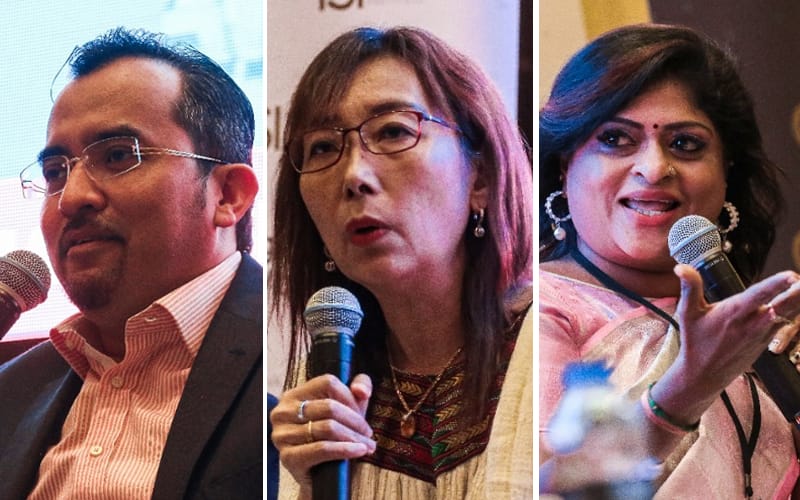
Asyraf Wajdi Dusuki of Umno, Teresa Kok of the DAP and Mohana Muniandy of the MIC say the public has a right to know where the funds come from and to whom they go.
Asyraf, the Umno youth chief, said his party would “definitely” be in favour of political funding reform, noting that former prime minister Najib Razak, as party president, had mooted the idea in 2014 but that it was met with resistance.
“Transparency is good and advantageous to us, because then we know who is our friend and who is yours.
“We would know who is actually sincere enough to contribute for the sake of our cause, instead of buying ‘insurance’,” he said, alluding to those who donate to all parties in order to cover their bases come election time.
He was speaking at the Malaysia Democracy Forum titled “Charting the Future of Parliamentary Democracy in Malaysia”.
It was organised by the International Strategy Institute (ISI).
Asyraf added that the public deserved to know where a party’s money was coming from, how it had been solicited and if any “benefit” was accorded as a result.
Seputeh MP Teresa Kok called for clearer laws on political funding, noting that in the Pakatan Harapan manifesto, any politician receiving RM20,000 and above had to declare the donation.
“After we became the government, we tried to push this into law but faced resistance from the business community. They told us it is tough to support it as they don’t want people to know,” she said.
Kok also said the difference between political funds and constituency development funds must be taken into consideration.
While in government, Kok said, they were allocated RM1 million under the constituency development fund by the Implementation Coordination Unit in the Prime Minister’s Department.
However, she said the funds were not handed over to them directly.
Kok said all political parties would need to come to a consensus on the amount and mechanism before passing a law.
“Let’s start with all agreeing to slowly change the mindset of businessmen,” she added.
She also suggested that companies be allowed tax exemption on the political donations. “We can discuss if this is workable.”
Mohana Muniandy, the former MIC Wanita national leader, said any law on political funding would be difficult to implement as the patronage culture has become ingrained in Malaysia’s politics.
Using the last general election as an example, where Pakatan Harapan ran on an anti-graft platform, she said its victory did not spell the end of corruption in Malaysia as graft had become very entrenched.
Tricia Yeoh, CEO of the Institute for Democracy and Economic Affairs, said whoever wanted to donate should be free to do so without any penalty as political parties needed funding.
However, she said utilising public funds for political parties, as in Germany, could be a game changer.