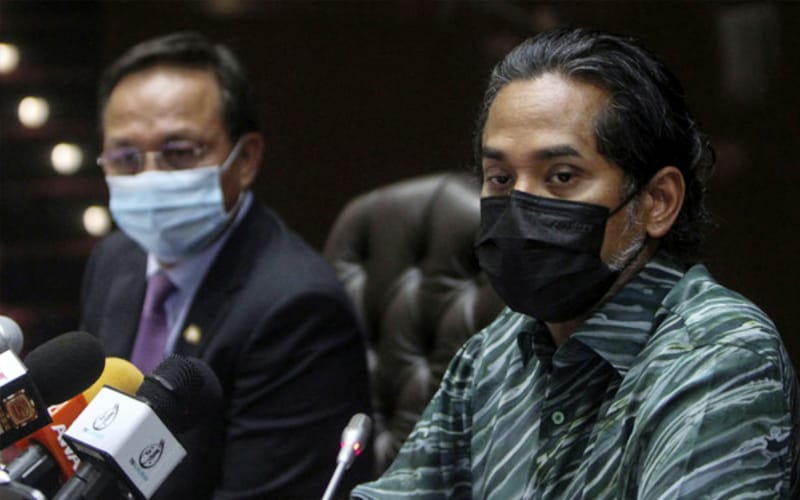
The National Covid-19 Immunisation Programme coordinating minister said backup plans had been drawn up in case the vaccine was found to be unsuitable for use in the country.
He said that a group of experts has been following the development of the vaccine and took note of several cases of blood clots identified by the regulatory body in the UK.
“However, we are still looking at the data and whatever the decision on the use of this vaccine, it will be announced later,” he said.
“If we have to defer, or if we find that AstraZeneca is unsuitable, we have some other (backup) plans. For example, we received an offer from Pfizer-BioNTech to add another 12.8 million doses, in addition to what we have ordered, which is about 30 million doses.
“This is still in the backup plan if it (AstraZeneca) cannot be administered,” he said in a press conference with Johor menteri besar Hasni Mohammad, at Bangunan Dato Jaafar here today.
He added that the special committee on Covid-19 vaccine supply access guarantee will hold a meeting on Tuesday to hear reports from a group of experts on the development of the vaccine.
Khairy, who is also science, technology and innovation minister, said Malaysia was scheduled to start receiving deliveries of the AstraZeneca vaccine in May, which involved procurement of 6.4 million doses for the use of 3.2 million people.
However, he advised the public not to worry as Malaysia was still using Pfizer-BioNTech and Sinovac vaccines.
In the meantime, he said that the Novavax vaccine was also among the vaccines being considered by the government, which is in negotiations with its manufacturer.
Asked about the South African B.1.352 Covid-19 variant, which was detected in the country recently, he said that he was considering adding vaccines that were seen to be effective against such aggressive variants, such as the Pfizer-BioNTech, Novavax and Johnson & Johnson vaccines.
Meanwhile, Hasni said that the Johor government will develop an application, Immu Plan Johor, to facilitate the registration for Johoreans who work in and commute to Singapore, including students and their guardians.
“The initial number that we discussed and submitted (for the application) to the ministry involves 100,000 individuals,” he said.