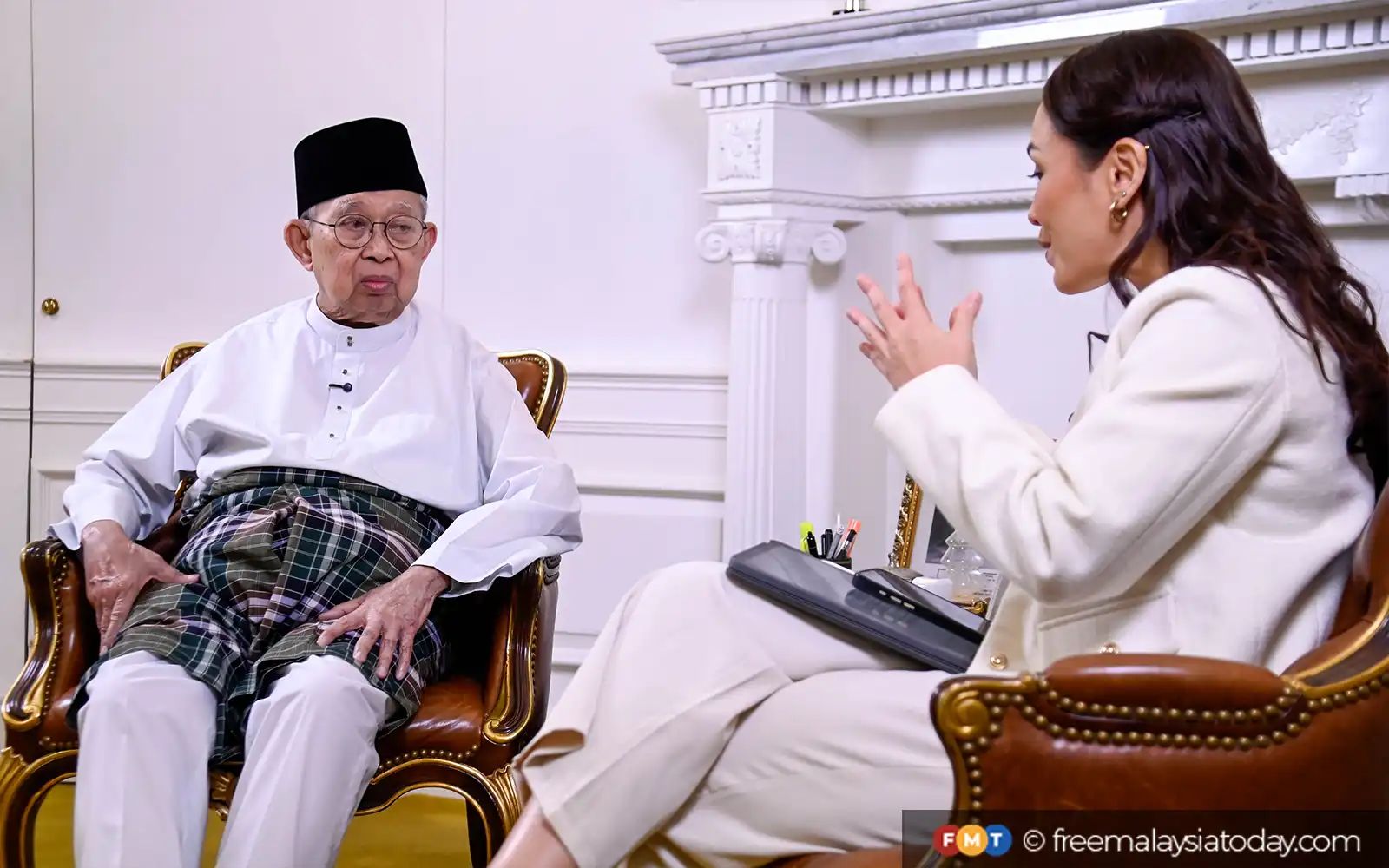
He said Putrajaya and the Sabah government should work toward concluding negotiations by adhering to the Federal Constitution, which sets the parameters within which both parties must operate.
Speaking exclusively to FMT, Tengku Razaleigh told host Jo-Anna Rampas that Sabah’s right to 40% of federal revenue derived from the state has never been in dispute.
What remains is the finalisation of a calculation formula acceptable to both the federal and state governments, he added.
“Forty percent is already in the agreement,” the former finance minister said.
“So, what we need to do is — you have teams to look into it and then finalise it as we go along. I don’t think it’s a big problem.”
Tengku Razaleigh added that any differences between the federal and Sabah governments on what constitutes state-derived revenue should be settled through negotiation rather than prolonged debate.
“Whatever discrepancies there are, you should settle to secure the future. Whatever is a problem now should be resolved,” he said.
“The resolution (must be) through negotiation (which should be conducted) reasonably, logically. There is nothing that cannot be resolved.”
Asked by Jo-Anna whether the matter suffers from a lack of political will, Tengku Razaleigh said it demands responsible leadership focused on resolving the issue and moving forward.
“The young want to move forward, move with progress, and we should encourage that to happen,” the veteran statesman said.
Jo-Anna, a Sabahan, acknowledged that the Madani administration had made significant progress on various Malaysia Agreement 1963 (MA63) matters, as reflected on the federal government’s MA63 Dashboard.
However, she said Sabahans were monitoring the 40% special grant issue very closely.
“I have to say, I feel that they (the Madani government) have done quite a lot, especially for Sabah. You need political will for that,” she said.
Tengku Razaleigh said there was no reason for negotiations to span generations.
“I think it just takes the committee to work harder and get the thing settled as you go along,” he said.
In October 2025, the Kota Kinabalu High Court affirmed Sabah’s constitutional right to 40% of net federal revenue collected from the state and ordered both governments to conclude negotiations within 180 days, by April 15.
The federal government did not appeal the ruling on the state’s entitlement, and Prime Minister Anwar Ibrahim subsequently committed to honouring it.
However, other aspects of the case are the subject matter of appeal. These include findings by the High Court that both the federal and Sabah governments had acted unlawfully since 1974, and that the post‑2021 review process undertaken was unlawful and procedurally flawed.
Putrajaya has applied to the Court of Appeal for a stay of the High Court order pending disposal of the appeal, which Sabah attorney-general Brenndon Keith Soh said the state intends to oppose.
The unresolve issue between the two governments is how the 40% share should be calculated, with both sides differing on which revenue items should be counted as derived from the state.
Anwar told Parliament last year that Putrajaya was determining which revenue streams fall under federal responsibility, and which should be attributed to Sabah. Until that is agreed, the final amount remains uncertain, he said.
Negotiations on the formula continue, and the issue is expected to loom large in Sabah in the lead-up to the 16th general election, which must be called by 2028.