Indeed, most artists express themselves via these time-tested mediums, using the canvas or the chisel to create meaningful works of art.
In truth though, art is a broad term and anything can be regarded as art when its sole purpose is to express a person’s creativity and imagination.
The current exhibition at Kuala Lumpur’s Weiling Gallery is proof of this, as it will likely challenge the way you view art.
“Closer Than Your Family” is likely the most curious art exhibition anyone could ever experience.
If you’re expecting to view paintings and sculptures, prepare to be intrigued as American artist and scientist Heather Dewey-Hagborg’s first solo exhibition in Malaysia is a rather mind-boggling one.
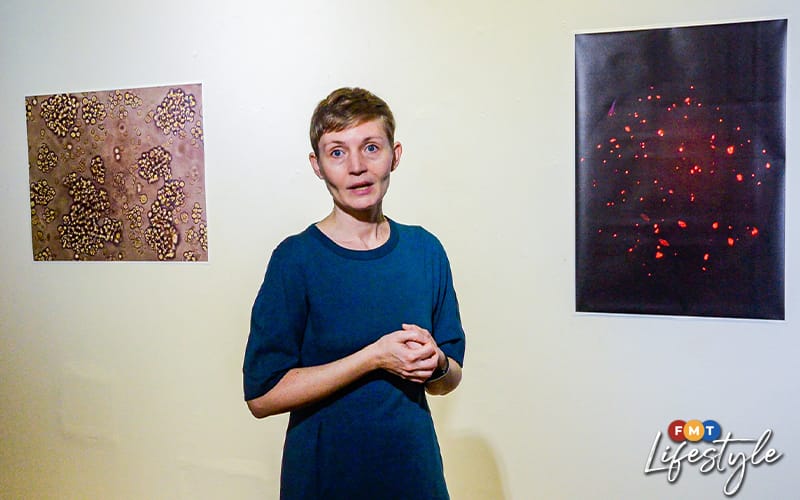
The gallery is currently home to four of Heather’s works, each of which walks a fine line between the fields of art and science.
First to be displayed is “Love Sick: The Transfection”, an art installation featuring an actual engineered virus. Cue the conspiracy theories.
But, yes, it’s true. For this artwork, Dewey-Hagborg worked with a laboratory to create a virus which actually increases the production of oxytocin in the human body.
Oxytocin is the hormone responsible for feelings of love and bonding and this artwork is meant as a statement against the rampant hate and intolerance in the world.
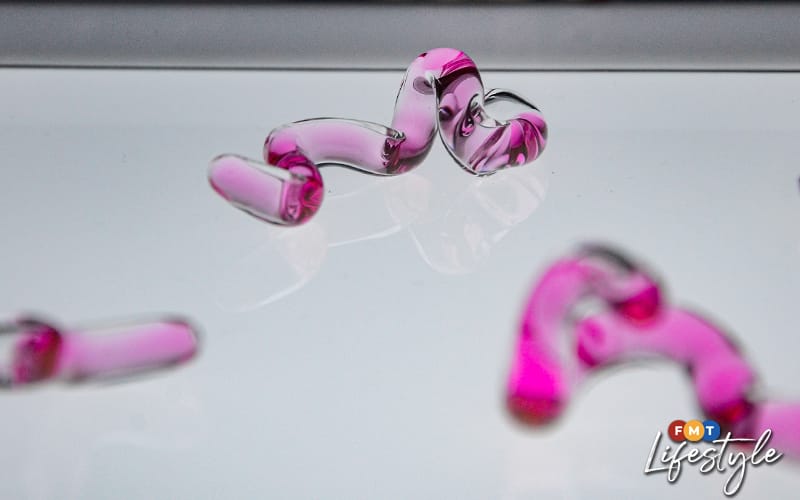
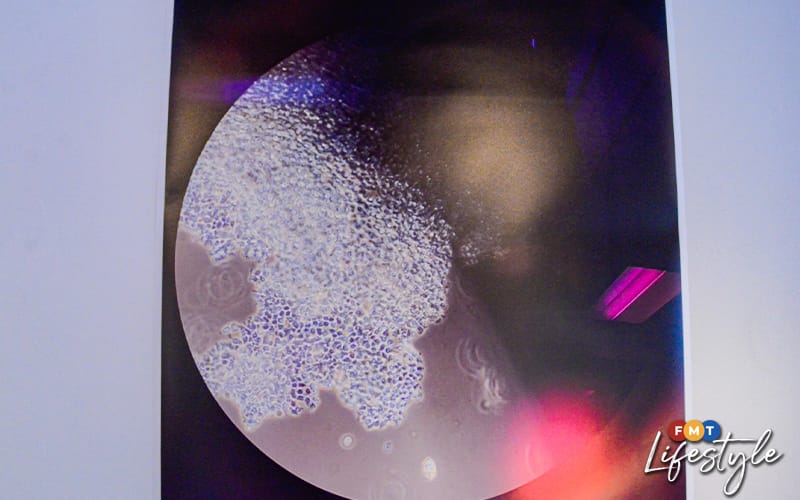
In addition to printed photographs of the virus infecting cells, “Lovesick” also features glowing vials of the virus; don’t worry, they’re deliberately deactivated.
It is also a reminder that humans are now capable of creating viruses, as unsettling as that is.
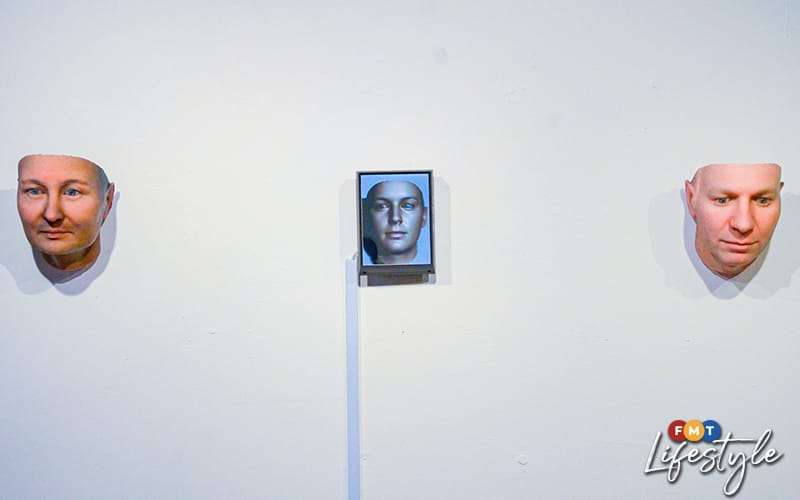
The next artwork, “Watson’s Ghost” is not about Sherlock Holmes’ famous sidekick, but rather James Watson, the man who claimed credit for discovering DNA.
This artwork features a pair of 3D-printed human faces, as well as a digital screen showing up to 200 portraits of different people.
The twist is that all these portraits are based on a single sample of Watson’s DNA, showing just how diverse a person’s genes can be.
According to Dewey-Hagborg, Watson had rather troubling ideas about race, sex, ethnicity and intelligence, and how one could “breed” the perfect human.
This artwork is thus a statement against Watson’s ideas, reminding viewers that genetics are just a small part of what makes people who they are.
The final exhibit is “Hybrid: An Interspecies Opera” which ties into another artwork called “Future Pigs”.
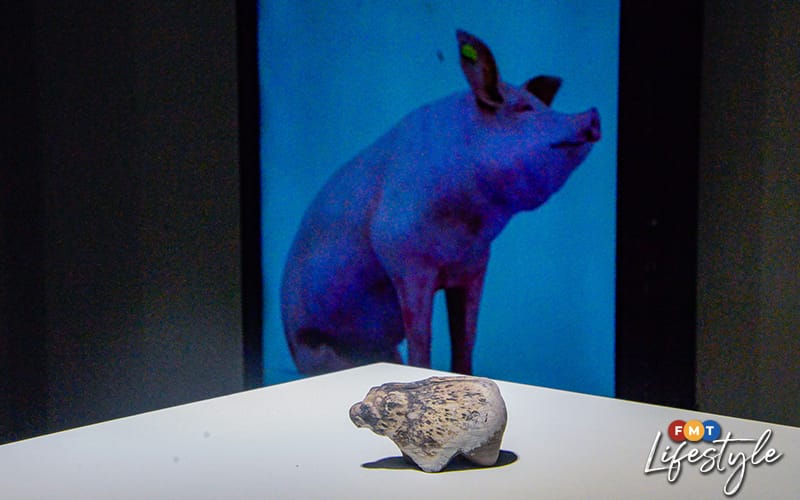
For “Future Pigs”, viewers are treated to three digital screens which show how pigs could evolve in the near future.
One screen shows pigs bred to have exotic animal coats, like a zebra’s stripes or a leopard’s spots. The other has a particularly ordinary pig, except fattened to maximise the number of edible parts.
The last screen is probably the most disconcerting depiction: a pig with human-like features. It’s probably a helpful reminder that genetically, pigs are rather similar to humans.
Speaking of genetic closeness, “Hybrid” touches on this concept, with it being a musical documentary on the relationship between humans and pigs.
Did you know that scientists are already working on ways to develop gene-edited pigs which can provide humans with organs for transplant?
Well, that’s apparently a thing now and it’s something you might just benefit from one day in the future.
If you listen carefully to the documentary, you might notice that the musical lyrics are actually the actual words of scientists studying the matter.
With how scientific her artworks are, one might wonder if Dewey-Hagborg is more a scientist than an artist.
Speaking to FMT, she confirmed she sees herself as the latter. “From a pretty young age, I was already mixing art with science. I have always wanted to put these two things together.”
“I was really interested with the idea of conceptual art, the idea that ideas themselves can be art,” she explained. “I liked that it engaged with my intellectual side too.”
She shared some of the stories behind her artworks, with “Lovesick” apparently being a product of the political climate.
According to her, the 2016 presidential election and the Brexit referendum inspired her to ask a laboratory director if humans could make a virus that would make people more loving.
“People had become so brutal with each other, and I was thinking of a biotechnological solution to bring people together.”
Before anyone gets alarmed, she does assert that the virus is extremely non-contagious. “For better or for worse, we’re not having a happy virus pandemic,” she joked.
Ultimately, her artworks are meant to encourage people to think and to contemplate just how far-reaching modern science can be, for better or for worse.
‘Closer Than Your Family’ is open for viewing by appointment only until April 15. For assistance, contact +60322601106 or e-mail [email protected]
Weiling Gallery
8, Jalan Scott
Brickfields
50470 Kuala Lumpur