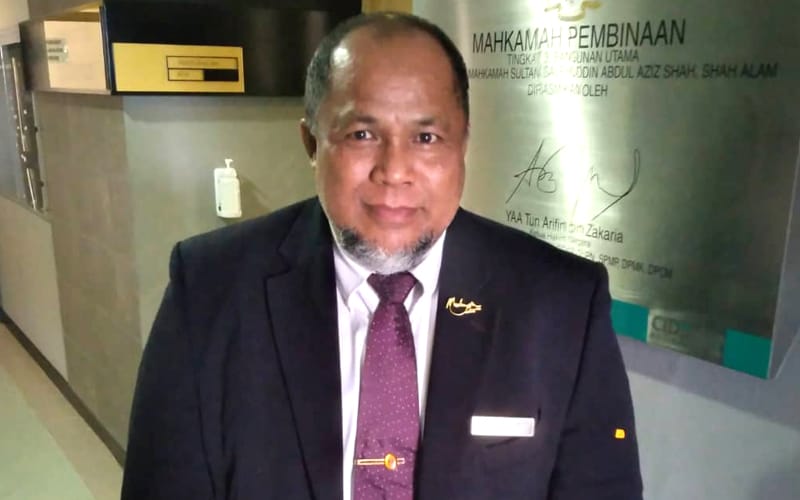
Former Firearms and Tool Marks unit head at the Chemistry Department, Shaari Desa, said the residue was from pentaerythritol tetranitrate (PETN) and cyclotrimethylene trinitratemine (RDX) which were defined as explosives under the Firearms Act 1957. RDX is also the explosive agent in C4 plastic explosives.
Shaari said that from his analysis, he only found PETN and RDX residues which were in the “highly explosive” category.
“Both are usually used in military activities and have velocity detonation of more than 1,000 metres per second,” the witness said when examined by Harshaan Zamani, the lawyer appearing for the family of the Mongolian woman.
He was testifying in a suit brought by Altantuya’s family against the government as well as several others.
Altantuya’s father, Setev, his wife, Altantsetseg Sanjaa, and Altantuya’s son, Mungunshagai Bayarjargal, have named political analyst Abdul Razak Baginda, and policemen Azilah Hadri and Sirul Azhar Umar as the other defendants in the suit.
The family, which alleges conspiracy in Altantuya’s murder, is seeking RM100 million in damages, including dependency claims.
Shaari, 54, who is now Penang Chemistry Department director, said the explosive power of RDX and PETN could cause extensive damage to the subject and would produce a supersonic blast wave.
The witness said that on Nov 17, 2006, investigating officer Tony Lunggan came to his office in Petaling Jaya and asked him to analyse exhibits collected from a crime scene.
Tony handed over 69 samples in envelopes and a package.
Shaari said there were, among others, explosive residue, hair, bone, plastic fragments, soil, a firearm and a casing.
Altantuya, 28, an interpreter, was murdered between 10pm on Oct 19, 2006 and 11am the following day in the jungles of Puncak Alam here. She was shot in the head before her body was blown up with explosives.
Razak, who was an aide to then-deputy prime minister Najib Razak, was charged with abetting Azilah and Sirul, but he was acquitted without his defence being called.
Sirul and Azilah, who were part of the police’s Unit Tindakan Khas (UTK), were convicted in 2009 by the High Court of killing Altantuya.
They succeeded in overturning their conviction at the Court of Appeal in 2013, but the Federal Court in 2015 restored their conviction and sentenced them to death.
Sirul fled to Australia before the final verdict. Neither Sirul, who is being held at an Australian detention centre, nor Azilah, who is on death row at Kajang Prison, have challenged the suit.
The hearing was adjourned to June 14.