
After a town hall meeting in September 2018, where Penang Forum suggested that the Penang government explore replacing the LRT with ART, the government sent a delegation to China in early 2019 to study the ART system.
To date, the public is still in the dark as to the findings of this study mission. We propose that the government at least give the public an account of the objectives of such trips, what was learned and adopted, what was not and why. What was the cost? We await their report. Meanwhile, the Sarawak state government also sent a delegation to study ART and has announced its intention of adopting this new technology.
Scholars have also visited China to study ART. Among the most prominent is Peter Newman who was awarded the 2018 Western Australia Scientist of the Year and who has studied train systems for over 40 years. He had this to say: “I went to China to check out the CRRC trackless tram (they call it autonomous rail transit, or ART). I came back convinced it’s a transformative transit technology.”
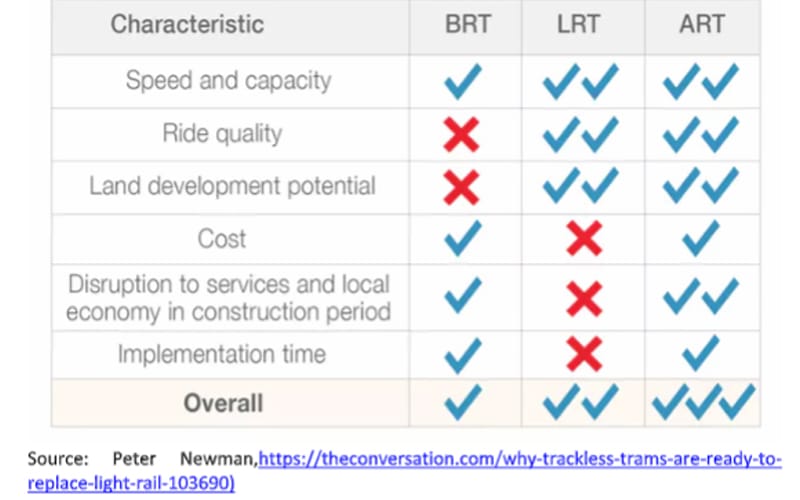
ART is cheaper, with researchers estimating construction costs at A$6 million to A$ 8 million (RM18 million to RM24 million) per km for each set of three cars plus a station, a fraction of the LRT which cost at least A$50 million (RM150 million) per km. Penang’s LRT is estimated to cost RM220 million per km, i.e. 10 times more expensive than ART.
ART is better, more flexible, and has the same, if not higher, carrying capacity. The standard ART system is three carriages capable of carrying 300 people. It can take five carriages and 500 people if need be. ART’s carrying capacity is estimated at 12,000 to 30,000 people per hour per km on a single 50km/h lane – higher than LRT which can carry 10,000 to 20,000 people per hour.
ART is much faster to install since no tracks are needed. It operates on an autonomous optical guidance system with GPS and Lidar technologies along invisible tracks. Trackless trams avoid the worst features of LRT – disruption and cost. It would take an estimated six to seven years to build the Penang LRT, causing major disruptions to Penang. According to Newman, ART lines can be painted literally over a weekend. It takes a few months to build the stations, not six years. Pre-fab stations can be installed.
ART can travel quickly and smoothly. Newman was on an ART and witnessed kids running up and down the tram aisle while it was going at 70km/h.
Australia is studying new ways of financing ART where private investors will pay for land along the route, road preparations, construction of tram carriages, and even operate the system in that corridor. In Penang, the Bayan Lepas-FTZ area is densely populated. ART corridors will benefit the private sector. In this regard, Penang can explore joint-ventures with private investors to determine the stations and route, build and operate the ART system.
“This allows for more efficient use of the infrastructure, new sources of funding, a reduction in car dependency, and increase in economic growth and productivity” (“Could trackless trams replace light rail?” by Daniel Jauk, Curtin University).
Table 2.1: Comparison of BRT, LRT and ART systems
Penang has a small but strong bus-building industry. Given that the ART technology is a cross between tram and bus, Penang should explore with China the possibility of a technology transfer.
In light of the above, the Penang government must justify why it is choosing LRT (which was last estimated to cost RM9.6 billion) over a technology that is better, cheaper and faster. It cannot hide behind the excuse that LRT is elevated and does not take road space.
Lim Mah Hui is a former professor and international banker and was on the Penang Island City Council for six years.
Ahmad Hilmy is a transport engineer and associate professor at Universiti Sains Malaysia.
The views expressed are those of the authors and do not necessarily reflect those of FMT.