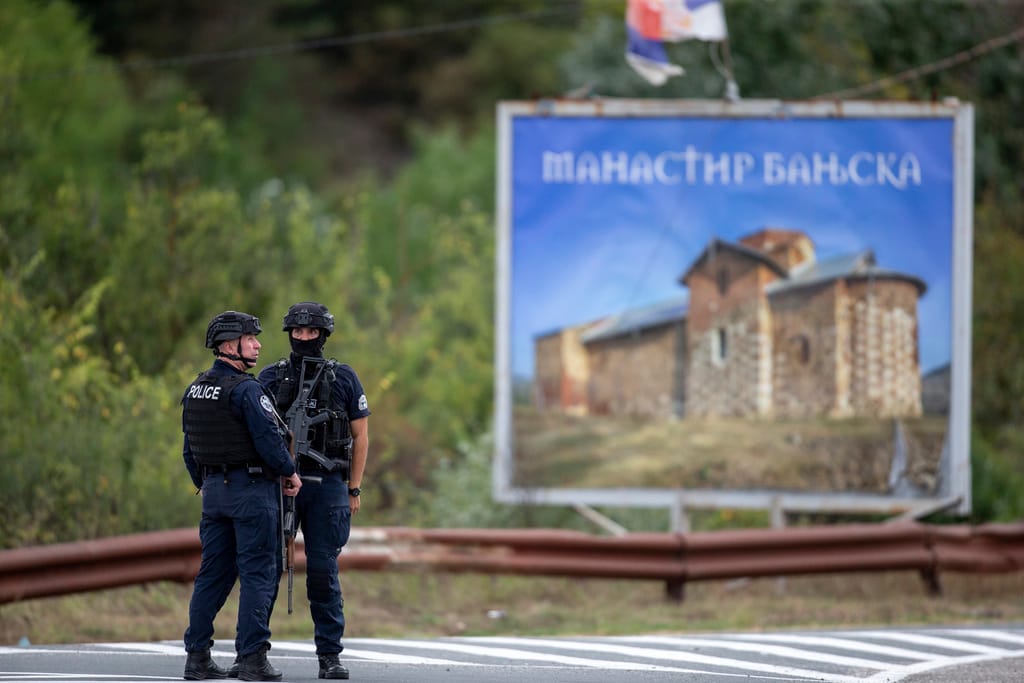
The gunmen stormed the village of Banjska yesterday, battling police and barricading themselves into a Serbian Orthodox monastery.
Police retook the monastery late yesterday, after three attackers and one police officer were killed.
The armed police units searched houses in the village today, looking for any gunmen who had not fled, a police source told Reuters.
The village was still sealed off to journalists this morning.
Ethnic Albanians make up a majority of Kosovo’s 1.8 million people.
But some 50,000 Serbs in the north of the former Serbian province do not accept Kosovo’s 2008 declaration of independence and see Belgrade as their capital, more than two decades after a Kosovo Albanian guerrilla uprising against Serbian rule.
Kosovo declared today a day of mourning after the police officer was killed.
Prime minister Albin Kurti has blamed Serbia for financing and sending armed men to Kosovo.
Serbian president Aleksandar Vucic has denied the allegations blaming Kurti for inciting violence by refusing to form an association of Serb municipalities to give more autonomy to Serbs and by launching frequent police actions in the north.
Josep Borrell, foreign policy chief of the European Union, which has sponsored dialogue since 2013 seeking to normalise ties between Serbia and Kosovo, spoke to both Kurti and Vucic yesterday.
Tensions have been running high since clashes in northern Kosovo in May when more than 90 Nato peacekeeping soldiers and some 50 Serb protesters were injured in northern Kosovo.
While ethnic Albanians form more than 90% of the population in Kosovo, Serbs are a majority in its northern region and have long demanded the implementation of an EU-brokered 2013 deal to create an association of autonomous municipalities in the area.