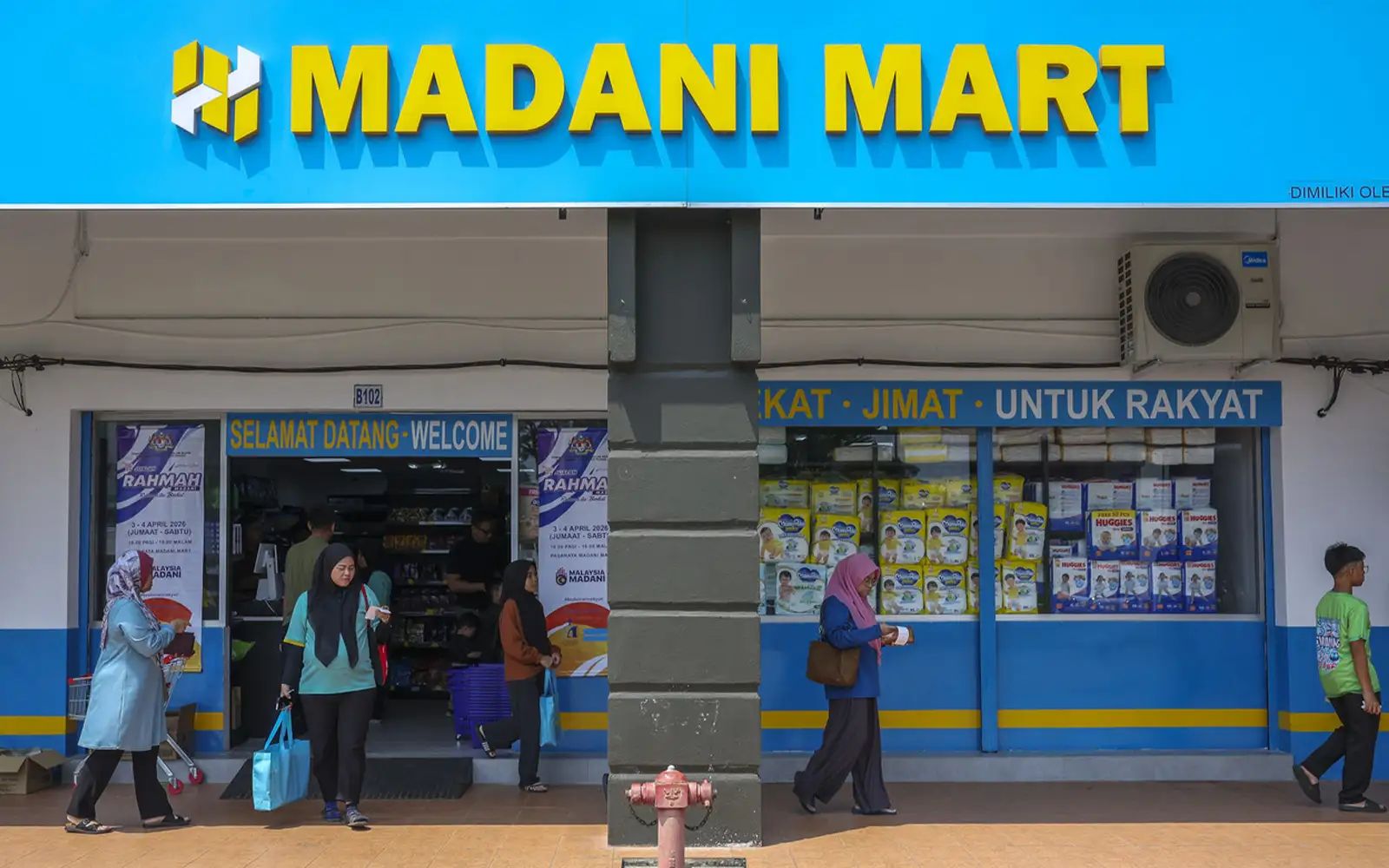
Operations manager Lufti Ariffin reiterated that Madani Mart does not adopt the same model as KR1M and is not financed by government funds or any single corporate entity in terms of its capital or operating expenditure.
“It would not be fair to project the failure of past initiatives onto Madani Mart or other new approaches,” the Yayasan Madani manager said in a statement today.
Lufti said each outlet is individually owned and operated by its respective operator, but still benefits from capabilities typically associated with larger retail chains, despite its small-format set-up of two shoplots.
“This is made possible as Yayasan Madani acts as an ecosystem builder and incubator, enabling economies of scale through structured supply chain coordination, centralised support systems, and strategic operational frameworks,” he said.
On concerns over its plan to set up an outlet in every state constituency, Lufti said this is part of a nationwide strategy to improve access to essential goods at “fair and affordable prices”, adding however that it would be rolled out in phases depending on supply chain readiness.
He said Madani Mart is currently setting up six distribution centres nationwide to support its rollout, with each centre serving clusters of outlets.
“Expansion will be guided by pipeline readiness and supply chain strength, ensuring that Madani Mart grows in a controlled, sustainable, and operationally sound manner, while progressively extending its reach to more people,” he said.
Since launching its first outlet in Kuantan, Pahang, Madani Mart has faced scrutiny, particularly over comparisons with KR1M.
Mydin Holdings Bhd managing director Ameer Ali Mydin had cautioned against repeating past mistakes, citing losses of up to RM100 million which the company sustained under KR1M before the last shop shuttered in 2017.