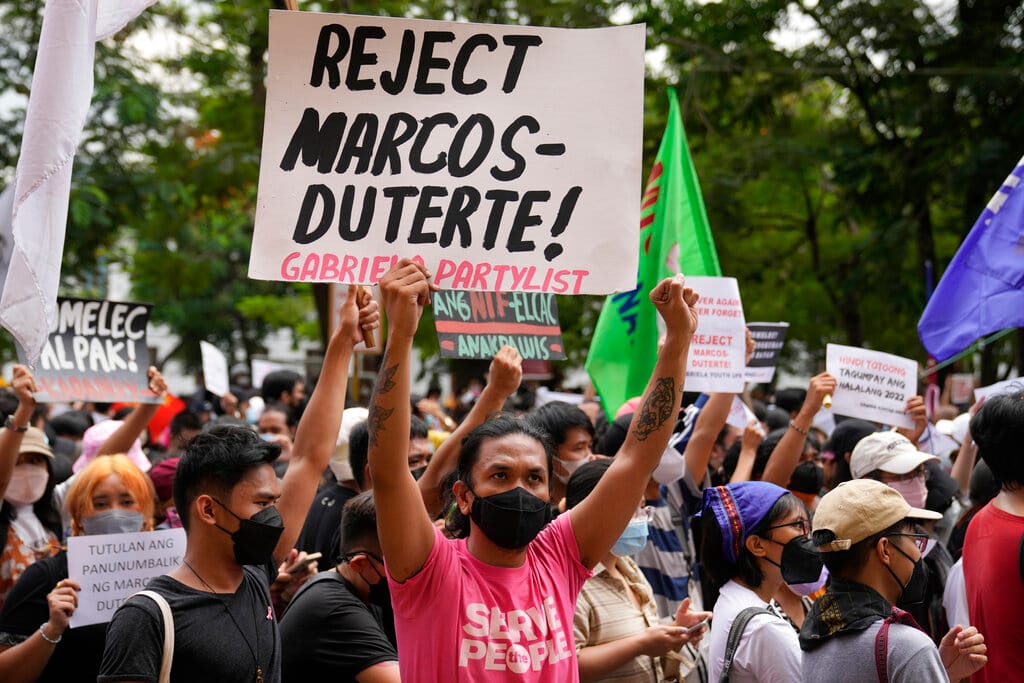
Normally, fans would be dressed in maroon for the University of the Philippines and blue for Ateneo de Manila University. But this game came just two days after Ferdinand “Bongbong” Marcos Jr, son and namesake of the late dictator, was elected president, and spectators heeded a call to wear sombre colours in protest.
“We used the game as a platform of protest because UP and Ateneo are two of the universities that have been at the forefront of fighting the Marcos regime since the ’70s,” Jonas Abadilla, president of the UP student council, told Nikkei Asia.
College campuses became fortresses against military intrusion and surveillance during the brutal 21-year rule of Ferdinand Marcos Sr.
Regardless of which president or party is in power, universities have been the hotbed for social activism in the Philippines. Students and professors have walked out of classes to protest against Marcos Sr, the corrupt administration of Joseph Estrada, and the Anti-Terror Law signed by president Rodrigo Duterte in 2020.
And now Marcos Jr has the strongest mandate of any president since his father, having commanded around 60% of the vote in Monday’s election.
With his election, a decimated opposition in Congress, and the threat of Marcosian historical revisionism, universities are once again charged with upholding their traditional role of keeping the government in check.
While it won mock elections in most of the country’s universities, the opposition was struggling long before the 2022 election cycle.
President Rodrigo Duterte’s Justice Department filed cases against several senators and succeeded in imprisoning senator Leila de Lima — one of his most vocal critics. Facing Duterte’s high approval ratings in the 2019 midterm elections, none of the Liberal Party’s eight senatorial candidates won any of the 12 seats up for grabs.
Vice-president Leni Robredo, the de facto opposition leader under Duterte, was unable to unite the opposition against Marcos, who ran as the continuity candidate. Robredo won more than 14 million votes on Monday, half of Marcos Jr’s tally but still a quarter of the vote.
“You have a fairly substantial percentage of voters … that are very, very hungry, very very committed to working actively for good governance, who are willing to become active participants in our democracy to ensure that good governance is upheld,” said Barry Gutierrez, Robredo’s spokesperson, in a TV interview on Tuesday.
Protests immediately broke out the day after the election. Supporters not only of Robredo but also of other candidates amassed outside the Commission on Elections to demand answers for election irregularities, such as 10-hour lines in polling places and broken counting machines.
“Whatever opposition we see from here on out will be an opposition largely determined and largely run by citizens, and this is a new thing in Philippine politics,” Gutierrez added.
Robredo and her running mate, senator Kiko Pangilinan, gained the endorsement of student councils and professors from UP, Ateneo, De La Salle University and other institutions who cited the pair’s qualifications, platform and track record. Marcos’s platform remained unclear throughout the campaign because he avoided presidential debates and media interviews.
“We’re not fighting because Leni and Kiko lost, but because we will lose our future, our education and our economy if Marcos and Duterte claim their positions,” said Abadilla.
Robredo and Pangilinan’s Senate slate also dominated university polls. But in the actual election, only incumbent senator Risa Hontiveros gained one of the 12 open seats.
With Hontiveros as the sole progressive voice, concerns have been raised about the Senate becoming a rubber-stamp body instead of a check on the administrative branch.
Duterte allies since 2016 have dominated the House of Representatives, but the Senate has tended to be more independent in questioning foreign policy and investigating government malfeasance through the Blue Ribbon Committee, a body tasked with holding public officials accountable.
The current committee chair, senator Richard Gordon, ran on Robredo’s slate and placed 22nd in Monday’s polls.
Asked how she would work with the heavily stacked Senate, Hontiveros said in a radio interview on Wednesday that “at several times we’ve collaborated across the minority-majority line for common advocacies”.
“I won’t be alone because the energy of the people’s campaign didn’t stop on election day,” she added, referring to Robredo’s grassroots and volunteer-driven campaign.
Hontiveros, an alumna of Ateneo, was greeted by cheers at the college basketball game on Wednesday. At halftime, both sides joined in a chant for Robredo and Pangilinan.
“The opposition, we intend to stay in this long and very serious game,” Hontiveros said, but added that she hoped the students’ walkout would not last as long. “We’re going to especially need educated, discerning and critically thinking youth and students now,” she said.