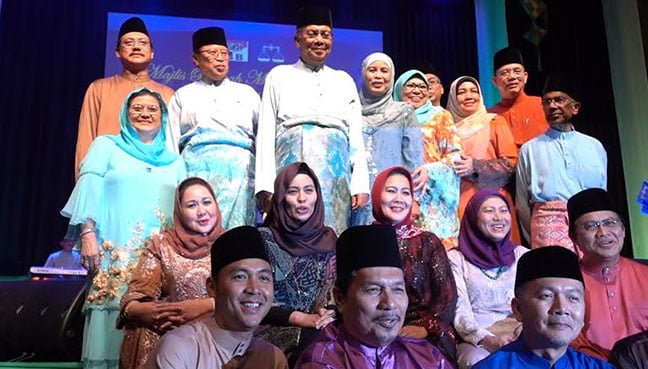
Adenan, who is PBB president and state BN chief, told an audience of about 1,000 that although the membership of the nine state assemblymen would present a conundrum to the state BN, he believed the component parties would be able to work out a new power-sharing formula.
PBB currently controls 40 of the 82 state seats. The dominant BN component, which comprises leaders from the Dayak, Malay, Orang Ulu and Melanau communities, only require two more assemblymen to be able to form a government on its own. With 49 state seats under its control, it is six seats shy of a two-thirds majority, allowing the component free reign to amend the state constitution on its own.
“If we had lost, that would have been problematic. Now that we’ve won, that is also problematic,” Adenan told party members and leaders of the Kuching division during an Aidilfitri appreciation dinner, Thursday night.
“We won 40 seats. But there are nine (party-less candidates) who wish to enter. If we accept all nine (candidates), then there would be 49 (state assemblymen). We are able to rule the state on our own. We would have the majority. Forty-two (seats) is enough already. So that has become a problem. A pleasant problem.”
They all want to join PBB, for whatever reasons, I don’t know. But I think you know the reasons. Now we have to decide whether to accept them or not. Personally, I am of the opinion that we accept all the nine,” he said, to applause.
“But I have to discuss the matter with my colleagues. We asked them to go back to their constituencies. They did, and the feedback is they still want to come to PBB. It is a compliment to us that they have faith in PBB. Now we are prepared to share power, yes. It doesn’t mean that once we get our own 49, we just appoint PBB members into our cabinet. No. We will still appoint other component parties, because we believe in sharing power.
“So that is the argument that we will use. So look forward and I hope that I have your support in admitting these people into PBB.”
“Do I have your support?”, he asked to some applause.
A total of 11 direct candidates won their state seats during the May 7 state election contesting under the BN banner. Of that number, nine remained party-less, or have defected from their parties of origin.
The nine are:
- Former Sarawak People’s Energy Party (Teras) president William Mawan, who is Pakan state assemblyman; Teras Senior Vice-President Rosey Yunus (Bekenu); and former party Treasurer-General Paulus Palu Gumbang (Batu Danau). Prior to resigning from BN-friendly UPP in hopes of joining PBB, the men were leaders from Sarawak Progressive Democratic Party (SPDP) in 2014.
- Former United People’s Party (UPP) Deputy President Dr Jerip Susil, who is Mambong assemblyman, former UPP Senior Vice-President Ranum Mina (Opar) and UPP Youth Chief Dr Johnical Rayong (Engkilili). Prior to defecting from UPP with hopes of joining PBB, the men were leaders from Sarawak United People’s Party (SUPP) in 2014.
- Former PBB members Gerawat Gala, a Kelabit and lawyer by profession who won the Mulu state seat; former PBB Youth committee member Miro Simuh (Serembu); and retired civil servant John Ilus (Bukit Semuja). The three men resigned from PBB prior to the recently concluded state election.
There was some opposition from leaders of smaller components. Prior to the election, Parti Rakyat Sarawak (PRS) President James Masing, who was recently appointed deputy chief minister, opposed PBB controlling more than half of state seats.
“If PBB has more than 41 seats, it means the notion of a coalition government is null and void because PBB can form the state government by a simple majority,” Masing was quoted as saying in April.
“Other state BN component parties like PRS, SUPP and SPDP will become irrelevant,” Masing said.
In the May 7 election, PBB won all 40 seats it contested. PRS contested and won all 11 seats. SUPP won seven of the 13 seats it contested, while SPDP won three of five seats it contested.
Eleven of 13 BN direct candidates fielded, won their state seats.
The remaining 10 seats were controlled by the Opposition DAP (seven seats) and PKR (three seats).
The current political development will likely make PBB’s coalition partners uneasy and is a long cry from PBB’s shaky beginnings.
In Sarawak’s first election in 1970, Parti Bumiputera Sarawak (Bumiputera) and Sarawak Chinese Association (SCA) won 15 of the 48 state seats under the Alliance party banner.
Bumiputera, which consisted of mostly Malay, Melanau and Orang Ulu leaders, won 14 seats while SCA took one seat.
Unable to form the government with such numbers, and after facing resistance from Dayak-based parties Pesaka and Sarawak National Party (SNAP), which won eight and 12 seats respectively, the Alliance turned to partner with SUPP, which won 12 seats.
Bumiputera later merged with Pesaka to form PBB in 1973, the same year the Alliance party changed its name to Barisan Nasional.
Since then, there has been an understanding among the state BN coalition that PBB should not hold more than half of the total number of state seats.