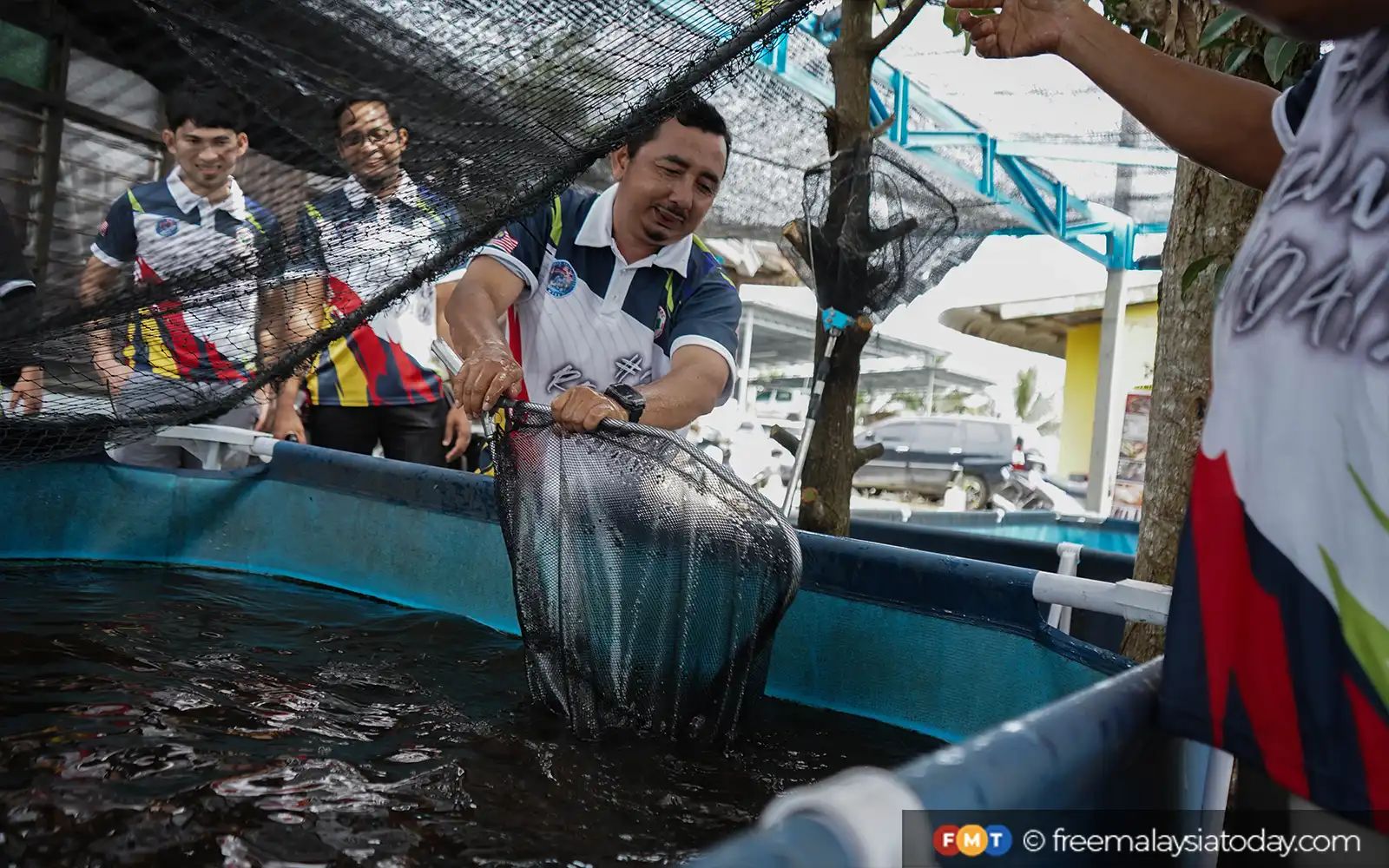
The initiative by the village development and security committee (JPKK) of Kampung Parit Empat to operate a freshwater fish farming and collection centre has transformed a shared pastime into tangible benefits for communities stretching from Parit 1 Timur to Parit 4 Timur.
Parit 1 Timur village committee chairman Zairul Hafiz Nor told FMT that fish caught by local anglers are collected and resold to nearby residents, creating a community-based supply chain that benefits both fishermen and buyers.
“Those who catch fish can supplement their household income, while residents are able to purchase fresh fish at prices lower than the market rate,” he said, adding that individuals who help secure buyers also earn commissions based on profits generated.

Beyond acting as a collection centre, the committee also operates its own aquaculture project. It now has 16 canvas ponds and five water tanks, housing freshwater species such as catfish, patin, tilapia, climbing perch, gourami, toman, eels, baung and bujuk.
Each pond contains 1,000 to 1,500 fish, depending on size, with a rearing cycle of three to four months before harvest.

“On average, we sell about 160kg to 300kg, depending on available stock. Prices range from as low as RM7 per kg to RM30 per kg, depending on the type of fish,” Zairul said.
He said the initiative was made possible through funding received under the Kampung Angkat Madani (KAM) programme, which aims to empower rural communities through targeted economic and social interventions.
The allocation was used to upgrade pond equipment and construct a new water intake system, drawing water from nearby drains using large-capacity pumps, replacing the use of treated tap water, he said.
“We also purchased borehole water filters, aeration pumps, vacuum-sealing machines for fish packaging, and freezers to improve storage and product quality,” he added.

Zairul also expressed gratitude to the Malaysian Space Agency, the coordinating agency for the KAM project, noting that its involvement went beyond infrastructure to include support for the village’s broader economic and social development.
Committee secretary Burhanuddin Zainuddin described the KAM programme as a platform to empower residents to generate their own income, rather than relying solely on padi farming.

“Our income has increased. While it is not substantial yet, it is enough to cover farming costs, pay the salaries of two full-time workers, and provide commissions.
“We hope this initiative will continue to grow and have a lasting, positive impact on more residents in the long term,” Burhanuddin said.